Harim Group, Korea’s Largest Agribusiness Company:
The ERP Innovation Journey Toward Real-Time Data-Driven Management
Harim Group ERP Transformation at a Glance
- Integration of 18 Affiliates: Harim Group integrated 18 affiliates and approximately 70 business sites into a single ERP platform, connecting previously fragmented processes, systems, and data into one cohesive structure.
- Enhanced Business Scalability Through a Block Built-in Architecture: By adopting a system based on validated standard process blocks, Harim Group significantly improved its ability to respond to business changes. The approach established a flexible IT foundation that enables rapid deployment of standardized templates when integrating new affiliates or expanding operations.
- Proactive Risk Management Enabled by Daily Visibility: By establishing a framework that provides daily visibility into critical management data such as inventory, shipments, and receivables, Harim Group shifted from reactive risk management to a real-time, proactive management approach.
- Accelerated Financial Closing and Decision-Making: The Group reduced its financial closing period from more than 12 days to approximately 5 days, significantly improving financial visibility and accelerating enterprise-wide decision-making.
Today, Harim Group is accelerating its transition to a truly data-driven management environment where employees across the organization share and utilize real-time data based on a unified standard.
Today, many companies are investing in advanced technologies such as ERP, data platforms, and Generative AI to establish data-driven management systems.
Yet despite substantial investments, data often remains fragmented, and decision-making still requires complex, multi-step processes. In many organizations, critical information such as inventory, shipments, and financial data still depends on manual Excel-based work and cross-departmental coordination to verify data consistency.
To overcome this structural challenge — where “systems exist, but data is not connected” — Harim Group partnered with Samsung SDS to embark on a transformation journey spanning its entire business value chain.
Fragmented Systems and the Lack of Management Visibility
Harim Group has rapidly grown by vertically integrating an extensive agribusiness value chain encompassing grain trading, shipping, feed production, livestock farming, meat processing, food manufacturing, and logistics distribution. However, through aggressive M&A-driven expansion, different systems and operational practices remained across affiliates, resulting in increasingly fragmented data and operational structures.
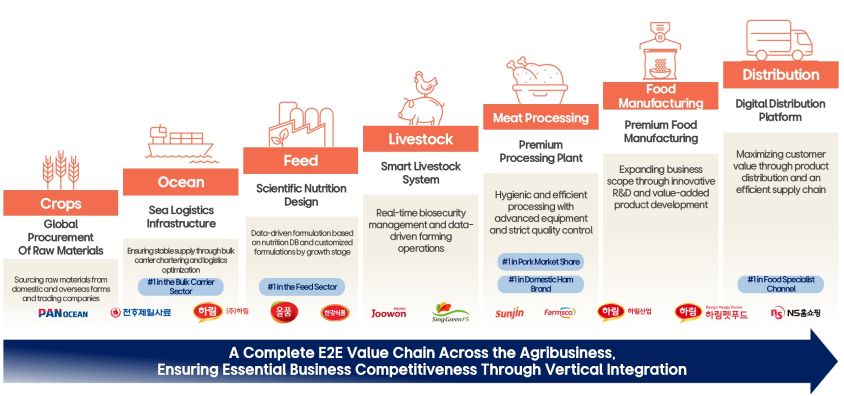 Harim Group Business Areas | Source: Samsung SDS
Harim Group Business Areas — end-to-end agribusiness value chain diagram spanning Crops (Global Procurement of Raw Materials, Pan Ocean), Ocean (Sea Logistics Infrastructure), Feed (Scientific Nutrition Design), Livestock (Smart Livestock System), Meat Processing (Premium Processing Plant), Food Manufacturing (Premium Food Manufacturing), and Distribution (Digital Distribution Platform), with a tagline: A Complete E2E Value Chain Across the Agribusiness, Ensuring Essential Business Competitiveness Through Vertical Integration | Source: Samsung SDS
This structural complexity became particularly challenging given the nature of Harim Group’s business. Across the entire lifecycle — from livestock farming and processing to distribution and delivery to consumers — the Group operates within a highly time-sensitive fresh food supply chain. Delayed data directly impacted physical operational flows, creating inefficiencies across the business.
The Group’s highly interconnected operating structure — involving affiliates, farms, and numerous business partners — further increased data fragmentation and management complexity. As a result, it became increasingly difficult to gain real-time visibility into enterprise-wide business operations, while system maintenance and operational resource burdens continued to grow.
Recognizing that management visibility through an integrated ERP platform could no longer be postponed, Harim Group began a full-scale transformation journey toward real-time data-driven management together with Samsung SDS.
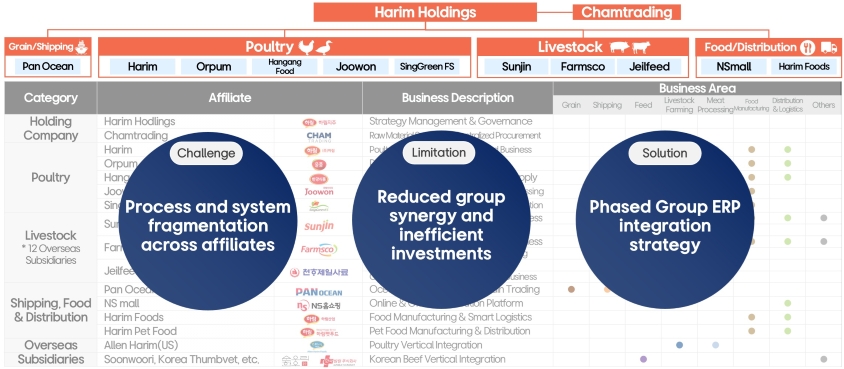 Harim Group’s Complex Operating Structure Across Diverse Business Areas | Source: Samsung SDS
Harim Group's Complex Operating Structure Across Diverse Business Areas — matrix showing 18 affiliates (Harim Holdings, Chamtrading, Pan Ocean, Harim, Orpum, Hangang Food, Joowon, SingGreen FS, Sunjin, Farmsco, Jeilfeed, NSmall, Harim Foods, etc.) categorized by Poultry, Livestock, Shipping/Food/Distribution, and Overseas Subsidiaries, with each affiliate's business coverage plotted across Grain, Shipping, Feed, Livestock Farming, Meat Processing, Food Manufacturing, Distribution, and Others; overlaid callouts highlight the three core challenges: Challenge — Process and system fragmentation across affiliates, Limitation — Reduced group synergy and inefficient investments, Solution — Phased Group ERP integration strategy | Source: Samsung SDS
- Disconnected Data: To verify critical business data such as inventory, shipments, and financial information, employees often had to contact each affiliate individually. Significant time was spent consolidating and validating data, while many tasks still relied heavily on Excel-based manual operations, making real-time visibility and data consistency difficult to achieve.
- Delayed Decision-Making: Different financial closing standards and systems across affiliates resulted in a group-level consolidated closing process that took more than 12 days. This delayed enterprise-wide visibility into key management indicators and limited the Group’s ability to respond quickly to rapidly changing market conditions.
- Reduced Responsiveness to Market Changes: As Harim Group expanded its B2C business and global operations, both its product portfolio and distribution structures became increasingly complex. The speed of market change also accelerated, making an integrated operational system capable of fast, data-driven responses more critical than ever.
Harim Group’s Strategic Approach: A Fundamental Transformation of Enterprise Management
Harim Group defined this ERP initiative not as a simple legacy system replacement or system integration project, but as a company-wide management innovation program fundamentally redesigning the Group’s operating model.
To achieve this, the Group established a “One ERP” environment integrating previously fragmented operational structures while balancing enterprise-wide standardization with the unique business characteristics of each affiliate.
Building an Enterprise-Wide ERP Beginning with Group Standards
Harim Group’s One ERP journey began with an integrated Process Innovation (PI) project aimed at defining standard processes to be shared across all affiliates.
Through detailed analysis of each affiliate’s processes, the Group identified a total of 3,373 process activities and successfully standardized approximately 85.9% of them into common group and industry-wide processes. This became the essential foundation for elevating operational capabilities across the organization.
Based on these standardized processes, Harim Group prioritized system integration for 18 affiliates, including five poultry companies and three livestock companies where process similarity and integration impact were the highest.
Master data covering farming, sales, procurement, production, finance, management, and HR was unified into standardized enterprise-wide formats, laying the groundwork for implementation.
Ultimately, ERP environments ranging from internally developed systems to SAP On-Premise solutions were consolidated into a cloud-based SAP S/4HANA platform, centralizing core business data within a single framework.
This large-scale transformation successfully connected approximately 70 business sites nationwide into one integrated system.
Flexible Operations Reflecting Industry-Specific Requirements
While securing enterprise-wide consistency through common standards, Harim Group also designed customized operational scenarios tailored to the business characteristics and external system integrations of each affiliate.
Applying identical standards uniformly across organizations with vastly different operating environments could have caused inefficiencies and resistance in the field. To address this, Harim Group integrated core processes and master data based on common standards while simultaneously designing flexible structures capable of accommodating affiliate-specific business requirements and operational expertise.
In particular, functions requiring integration with specialized external systems or differentiated business processes were configured based on affiliate-specific operational scenarios.
As a result, Harim Group achieved both enterprise-wide standardization and operational flexibility — building an IT environment optimized for its vertically integrated business structure.
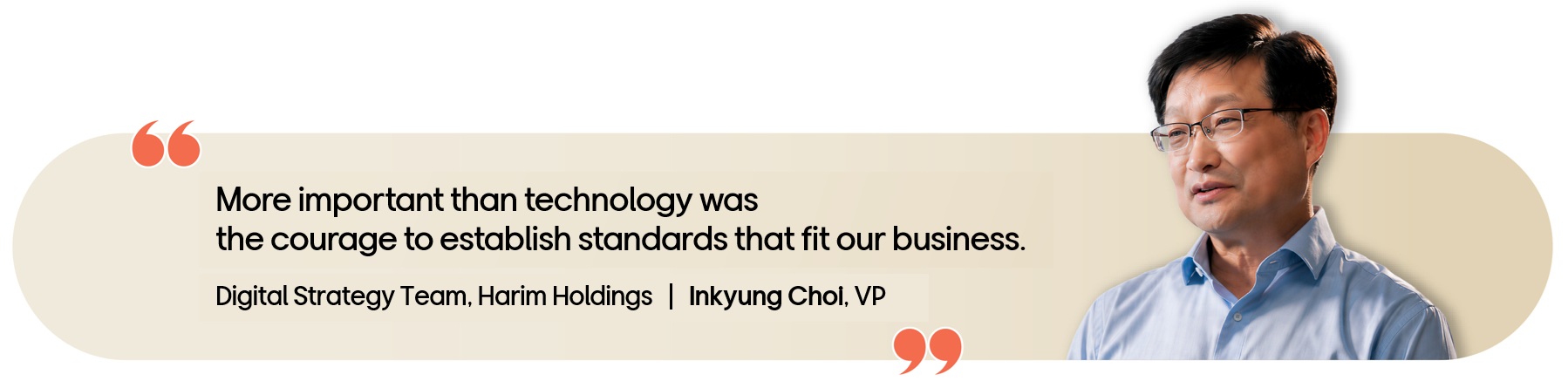
Interview quote card — Inkyung Choi, VP, Digital Strategy Team, Harim Holdings: 'More important than technology was the courage to establish standards that fit our business.'
Q. Integrating different systems and business processes into one platform must have been challenging. What was the most difficult part?
A.
The most difficult challenge was aligning different standards and operational methods into a single framework.
Harim Group has numerous affiliates and a highly complex ecosystem involving multiple partners and production entities. Even identical tasks were handled differently across organizations. Since these practices had evolved over long periods within different operational environments, naturally there were many differing opinions when trying to unify them.
However, accommodating every individual requirement would eventually create another fragmented system. Therefore, we prioritized long-term stability and scalability for “Harim Group’s next 10 years” over short-term convenience.
We focused on clearly distinguishing between areas requiring common standards and areas that needed operational flexibility depending on circumstances. This allowed us to reduce system complexity, improve efficiency, and create a structure that could deliver long-term value.
A Sustainable Operating Structure: Standard-Based Block Built-in Architecture
To build a sustainable operational framework capable of adapting to evolving business environments and continuously advancing technologies, Harim Group adopted a template-based “Block Built-in” approach.
Unlike traditional implementation methods that require new development for every individual requirement, this approach designs systems around validated standard process and functional blocks while selectively applying only necessary components.
This significantly reduced system complexity while simultaneously improving maintenance efficiency and business scalability.
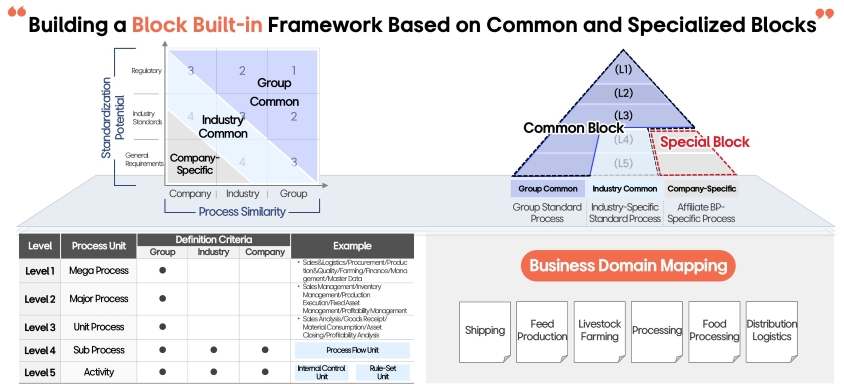 Definition of Standard Processes Shared Across All Affiliates | Source: Samsung SDS
Building a Block Built-in Framework Based on Common and Specialized Blocks — (Left) 2x2 matrix with axes Standardization Potential vs. Process Similarity, dividing processes into Group Common (quadrant 1), Industry Common (quadrant 2), Company-Specific (quadrant 3/4), and General Requirements (quadrant 4); (Center) pyramid diagram showing L1-L5 process layers divided into Common Block (L1-L3: Group Common and Industry Common Standard Processes) and Special Block (L4-L5: Affiliate BP-Specific Processes); (Bottom-left) definition table mapping each level (Mega Process, Major Process, Unit Process, Sub Process, Activity) to Group/Industry/Company criteria with examples (Sales/Logistics/Procurement, Production, Finance/Managt, Master Data, etc.); (Right) Business Domain Mapping across Shipping, Feed Production, Livestock Farming, Processing, Food Processing, Distribution Logistics | Source: Samsung SDS
In addition, the One ERP platform was implemented in a cloud environment, reducing infrastructure management burdens while enabling seamless adoption of evolving technologies over time.
Rather than remaining a static system fixed at a specific point in time, the platform established a foundation capable of continuous advancement and innovation.
As a result, Harim Group secured a sustainable IT operating structure that supports both current operational efficiency and future business expansion.
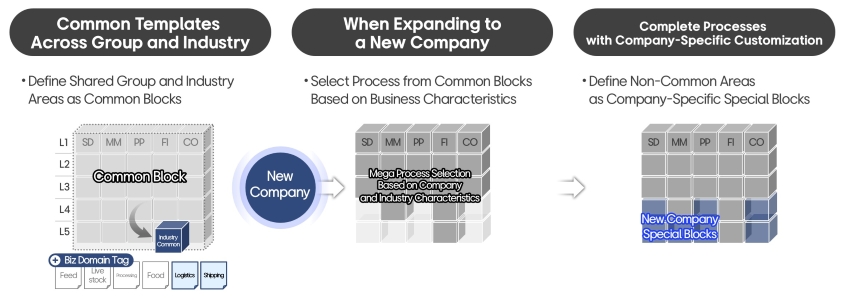 Structure Designed for Rapid Deployment Based on Standardization | Source: Samsung SDS
Structure Designed for Rapid Deployment Based on Standardization — three-step flow diagram: Step 1 Common Templates Across Group and Industry (define shared Group and Industry areas as Common Blocks, shown as a full SD/MM/PP/FI/CO block matrix with L1-L5 layers and Biz Domain Tags for Feed, Livestock, Processing, Food, Logistics, Shipping) → Step 2 When Expanding to a New Company (select process from Common Blocks based on business characteristics via Mega Process Selection) → Step 3 Complete Processes with Company-Specific Customization (define non-common areas as Company-Specific Special Blocks, highlighted in the matrix) | Source: Samsung SDS
Partnership and Trust Proven in Times of Crisis
Large-scale system transformation projects are inevitably accompanied by unexpected challenges. In highly interconnected operational environments, even a small issue or bottleneck can disrupt entire business processes.
Shortly after system go-live, Harim Group faced a critical situation where performance issues within legacy systems disrupted shipment operations across poultry affiliates connected through approximately 70 business sites.
What proved critical at that moment was Samsung SDS’s integrated response capability.
In many projects, issues outside the scope of a specific solution often delay root cause identification and response. However, Samsung SDS approached the situation from an end-to-end process perspective, diagnosing how localized issues were affecting the broader operational flow across logistics, finance, ERP, legacy systems, and interfaces.
Specialized experts were immediately deployed onsite to reassess the overall architecture, including interfaces and system performance, enabling rapid stabilization of operations.
This became a defining moment that demonstrated not only technical execution capability but also the strength of true integrated partnership in protecting uninterrupted business operations under complex crisis situations.
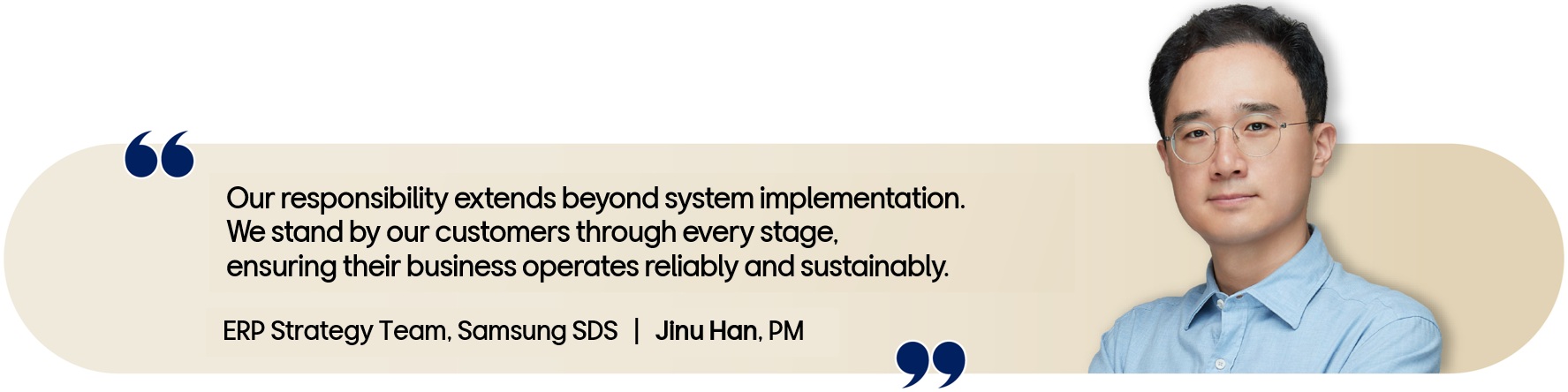
Interview quote card — Jinu Han, PM, ERP Strategy Team, Samsung SDS: 'Our responsibility extends beyond system implementation. We stand by our customers through every stage, ensuring their business operates reliably and sustainably.'
“True partnership is proven during unexpected crises.
From a project management perspective, the success of a large-scale ERP initiative goes beyond technical implementation. It depends on the commitment to ensure that the customer’s business never stops regardless of circumstances.
Because we had a deep understanding of Harim Group’s business and operational processes, we were able to immediately deploy experts across logistics, finance, ERP, and legacy systems during the crisis.
Breaking down the boundaries between systems and leveraging full-stack response capabilities to diagnose and resolve issues from an end-to-end process perspective was both our responsibility and our commitment as Samsung SDS.
Ensuring uninterrupted real-time data flow across the entire enterprise value chain — and protecting the value of Harim Group’s business throughout its innovation journey — was the true role and mission we promised as a strategic partner.”
“Now We Can See Everything”: Realizing Real-Time Data-Driven Management
The greatest asset Harim Group gained through system integration was enterprise-wide management visibility.
Previously fragmented data across affiliates was consolidated into a single system, enabling executives to monitor key business indicators such as inventory, production, shipments, and receivables in real time.
Instead of gathering information manually across multiple organizations, Harim Group established an environment where immediate decision-making is possible based on a Single Source of Truth.
This transformation went far beyond improving information accessibility — it fundamentally changed the Group’s operational model.
As data visibility cycles shortened, the speed of core management activities such as financial closing improved dramatically, while a daily operational closing framework became firmly established.
The Group also transitioned from reactive management to proactive risk monitoring and control, while enterprise-wide access to data created a more collaborative and transparent work environment.
Financial Closing Innovation: The Group reduced its financial closing period from more than 12 days to approximately 5 days, dramatically improving financial visibility and accelerating enterprise-wide decision-making.
Proactive Risk Management: By integrating data previously scattered across multiple systems and operational blind spots, Harim Group significantly strengthened operational precision and governance capabilities, establishing a more robust data-driven management system.
A Flattened Collaborative Environment: Harim Group established a foundation enabling integrated utilization of data across the entire value chain — from production and distribution to consumption.
Rather than allowing specific departments to monopolize data, the organization now operates under shared standards (“One Spec, One Code”), fostering transparent communication and faster decision-making across the enterprise.
Q. One of the goals of this project was to establish a data-driven decision-making system. What changed the most through this initiative?

The biggest change is that our perspective on data has fundamentally expanded.
Previously, financial closing alone took more than 10 days, meaning we only received performance results a month later. Now, five days is sufficient. We review key indicators such as inventory, shipments, and receivables every morning and immediately identify potential risks.
Today, Harim Group employees no longer debate “whose data is correct.” Instead, everyone works from a Single Source of Truth and focuses on discussing “how we should respond.”
The quality of decision-making itself has changed.
By creating a flattened environment where all employees can utilize data based on transparent standards, everyone now works from the same information and makes decisions based on shared criteria — dramatically accelerating decision-making speed.
This transformation also aligns with growing social expectations for transparent and accountable management.
Harim Group’s Next Challenge: Building an Intelligent Future Powered by AI and Data
Building upon the stable data foundation established through the One ERP project, Harim Group plans to further develop an AI-driven intelligent management system.
The Group aims to enable AI to analyze real-time data across the entire value chain — from product planning and production to distribution and consumption — to support optimized decision-making and establish smarter business operations.
Through this transformation, Harim Group seeks to evolve into a highly competitive global food company capable of responding faster than anyone else to changing market conditions.
Q. What would you like to say to companies preparing for AX (AI Transformation)?

No matter how advanced the technology is, it becomes meaningless if the underlying data foundation is disorganized.
Organizations must first establish clear standards tailored to their own business environments. Once you understand what data is being collected, you can begin identifying how to connect that data to operations. From there, you can envision how future technologies will actually be utilized in day-to-day business activities.
The most important lesson from Harim Group’s journey is not “which tools were implemented,” but rather “how persistently operational complexity was simplified.”
Today, many companies dream of business innovation through advanced AI technologies, yet often overlook the essential prerequisite: standardized business processes and integrated data foundations that enable those technologies to function effectively.
Ultimately, the success of digital transformation depends not on the technology itself, but on building the optimal foundation where technology can operate successfully.
Harim Group’s establishment of enterprise-wide standardization and a unified data utilization structure was not simply about improving current operational efficiency — it was about securing the most reliable foundation for entering the AI era.
Even Generative AI and intelligent automation cannot fully realize their potential without connected data infrastructure.
If organizations want to determine whether they are truly ready for future technologies, they must first examine how transparently and seamlessly their data is connected today.
Harim Group’s case demonstrates an enduring truth of digital transformation: building a strong foundation is ultimately the fastest path toward leading innovation in the AI era.