NC: Accelerating Global Infrastructure Expansion with Hybrid Cloud and Global Delivery Capabilities

NC Global Infrastructure Transformation at a Glance
- Global Site Deployment Time Reduced by 64%: A standardized parallel deployment approach shortened the planned deployment time from 120 days to 43 days.
- Hybrid Cloud Tailored to Service Characteristics: NC used public cloud for services requiring rapid scaling and on-premises infrastructure for workloads where predictable performance and operational control were critical.
- A Global Network Connecting Clouds, Data Centers, and Regions: Built on Samsung SDS's global network, NC connected its distributed infrastructure while preserving regional independence and securing global service connectivity.
- A Repeatable Model for Global Expansion: NC established a Playbook and a standardized Build-Learn-Optimize-Repeat cycle, creating a foundation for applying lessons from earlier deployments to future sites.
Even subtle changes in traffic at the moment players connect can change the quality they experience in a game service. When a new title launches or a major update goes live, concurrent users can surge within a short period of time. As services expand across regions, infrastructure environments and player access paths also become increasingly complex.
NC's game services have evolved from independent regional services to multi-region¹ and global services. Early titles such as Lineage (1998) and AION (2009) operated with separate services and infrastructure in each region. Starting with Guild Wars 2 (2012) and Lineage M (2017), NC introduced a multi-region architecture connecting regions within geographic zones. With Lineage W and AION 2, NC advanced to a global network model connecting players and services worldwide.
As NC expanded into more regions, operating independent infrastructure in each region was no longer enough. NC needed to connect infrastructure distributed across multiple regions while maintaining consistent service quality and operating standards.
To address this challenge, NC partnered with Samsung SDS to transform its global infrastructure with a hybrid cloud model. Samsung SDS connected cloud, on-premises infrastructure, data centers, and networks into a single service structure, supporting the transformation from overseas deployment through ongoing operations.
Global Reach. Consistent Quality.
NC's global infrastructure had to handle massive load while maintaining stable network quality, and apply consistent operating standards even when regional environments differ. To achieve this, NC defined four infrastructure requirements.
- Handling Extreme Load: Responding to simultaneous surges in traffic, packets per second (PPS)², and concurrent users
- Maintaining Network Quality: Reducing latency, jitter³, and packet loss while minimizing quality gaps between regions
- Unifying Global Infrastructure Standards: Applying a common architecture and operating standard to infrastructure distributed across multiple countries and regions
- Adapting to Regional Environments: Configuring infrastructure to reflect country- and ISP⁴-specific access environments, data center and cloud conditions, traffic characteristics, and regulatory requirements
NC had to uphold common standards across regions while reflecting each region's characteristics, and keep network quality stable even under extreme load.
The Right Mix for Game Services: Hybrid Cloud
NC did not choose an infrastructure environment first. It began with three guiding principles: Quality, Performance, and Operation. NC examined whether it could maintain stable network quality across the entire path between players and game servers, secure the processing capacity it needed as services scaled, and manage monitoring, deployment, recovery, and scaling under one consistent standard regardless of where the infrastructure was located.
Based on these principles, NC assigned roles to public cloud and on-premises infrastructure. Public cloud was used for new services and regional expansion requiring rapid launch and elastic scalability. On-premises infrastructure was used for steady-state workloads requiring predictable performance and cost, as well as strong operational control. Hybrid cloud was not a predetermined answer. It was the result of assigning each environment a role based on service and workload characteristics.
NC worked with Samsung SDS to translate these selection criteria into an infrastructure configuration. Samsung SDS connected public cloud and on-premises environments according to NC's workload requirements, creating an integrated service environment spanning data centers and networks.
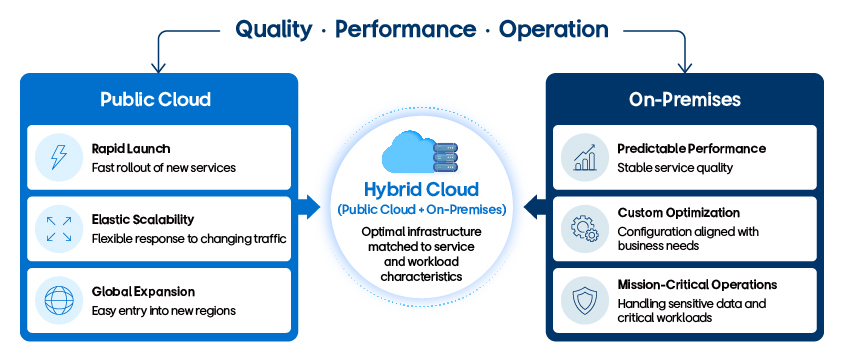 A Hybrid Cloud Configuration Tailored to Service Characteristics | Source: Samsung SDS
Q. What mattered most to NC when choosing its infrastructure?

“For us, the question wasn't 'cloud or on-premises.' It was 'Which infrastructure was the better fit for NC's game services?'"
— Soon Yong Hwang | Team Leader, Infrastructure Engineering Team, NC
Independent Regions. One Operating Standard.
As NC translated its strategy into infrastructure, it had to preserve each region's independence while securing global connectivity across a multi-region environment. Each region was built on independent, standardized infrastructure so that a failure in one region would not spread to others.
At the same time, NC standardized the global common services used by all regions, including DNS⁵ and NTP⁶, together with operating policies and management and monitoring frameworks. By connecting each region's network to this global common foundation, NC made it possible to operate physically distributed infrastructure under consistent standards and operating practices.
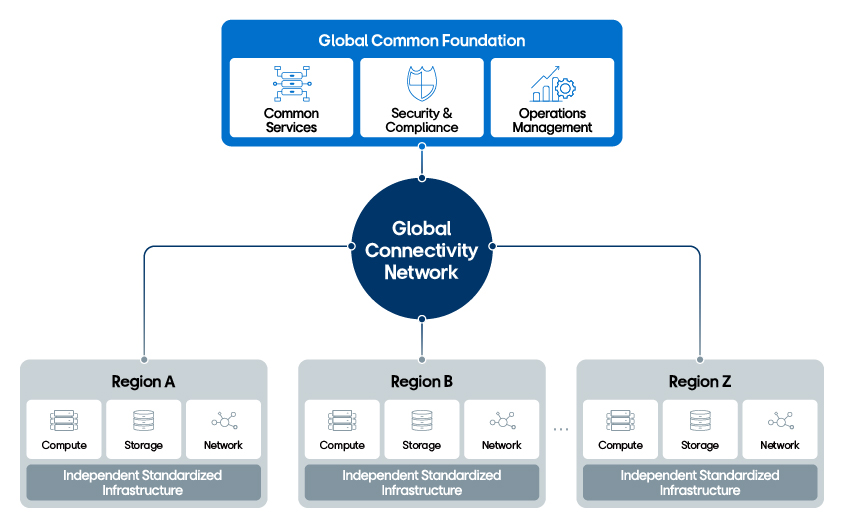 An Infrastructure Architecture Combining Regional Independence and Global Connectivity | Source: Samsung SDS
NC connected its regions through Samsung SDS's global network and linked them with major cloud providers such as AWS, Google Cloud, and Microsoft Azure. The architecture also allows NC to expand to additional cloud providers and global sites as needed.
"Turning two different infrastructures into one—that is the role of the network."
— David Lee | Group Leader, Cloud N/W Biz/Product Planning Group, Samsung SDS
Putting NC's Infrastructure Standards into Practice
NC analyzed game service demand and capacity to define the target architecture, infrastructure standards, quality objectives, and acceptance and operating criteria. Building on this, Samsung SDS developed the detailed infrastructure architecture and integration design, then implemented the resulting design across NC's global infrastructure. Samsung SDS handled the entire process end to end, from global infrastructure procurement and overseas deployment to coordination with telecommunications and data center providers and partners, through to operational handover.
Global infrastructure deployment requires accounting for differences in telecommunications environments, data center conditions, service providers, and implementation constraints across countries and regions. Samsung SDS drew on its Global One-Team model—which connects specialists at headquarters with local teams overseas—together with its global network backbone to implement common architecture and operating standards adapted to the conditions of each region.
After deployment, NC manages its global infrastructure through centralized remote operations, while Samsung SDS supports operations through specialists at headquarters, local teams overseas, and 24/7 support. Samsung SDS also applies standardized processes and operational automation, and continuously measures and improves system and network quality based on actual service data. This allows the standards established during deployment to continue through day-to-day operations.
Q. Why did NC choose Samsung SDS as its partner?

“We needed more than equipment procurement. We also considered global network infrastructure, local delivery capabilities, 24/7 operational support, and a long-term partnership.”
What NC valued was Samsung SDS's delivery capabilities: technical expertise in connecting cloud and network environments, combined with overseas deployment and ongoing operational support.
Planned for 120 Days. Built in 43.
For global game services, infrastructure must be in place by the time new regions and services are ready to launch. NC and Samsung SDS combined the system and network standards NC had established with Samsung SDS's capabilities in global procurement, overseas deployment, and provider coordination to enable parallel deployment of two regions based on validated standards.
The original plan was to build Region A first and then proceed to Region B, a sequential approach expected to take about 120 days. Building on these standards and Samsung SDS's global delivery capabilities, NC shifted to parallel deployment of the two regions. As a result, NC completed deployment of both regions in 43 days, shortening the planned deployment time by approximately 64% and enabling an earlier service launch.
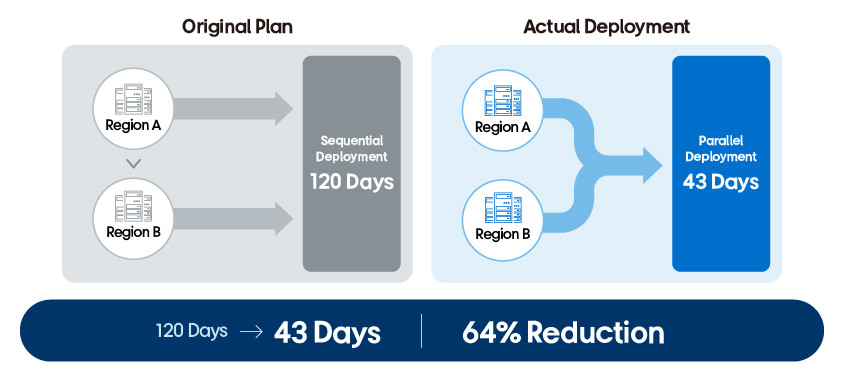 From Sequential to Parallel Deployment of Global Sites | Source: Samsung SDS
One Deployment Makes the Next Faster and Better.
NC organized the architecture, operating standards, and deployment know-how established through this project into a standardized execution guide, the Playbook. For each new site, NC applies validated designs and procedures, and feeds improvements identified in the field back into the Playbook. This reduces the burden of designing each site from scratch, and as experience accumulates, NC can shorten deployment lead times while improving delivery quality.
Q. How has this experience changed the way NC prepares its next site?

"We can now use our experience from earlier deployments to prepare the next site faster and more reliably."
As NC enters new markets and launches new services, it can use this validated expansion model to prepare the sites it needs quickly. The foundation established through this project will support NC as it continues to expand its global game services.
Footnotes
- Multi-Region: A configuration in which a service is delivered from infrastructure distributed across multiple geographic regions.
- PPS (Packets Per Second): The number of network packets processed per second.
- Jitter: Variation in packet transmission delay over a network.
- ISP (Internet Service Provider): A telecommunications provider that delivers internet access services.
- DNS (Domain Name System): A system that resolves domain names into IP addresses.
- NTP (Network Time Protocol): A protocol used to synchronize time across systems on a network.