
Accelerated Server (GPU/NPU)
Virtual AI Accelerator Computing Service for AI Training and Inference
Comparison of Accelerated Server Types
GPUs handle both graphics and large-scale general computing simultaneously, whereas NPUs are dedicated processors engineered to run AI computations with speed and efficiency.
The key differences and features of the two processors are follows.
| Category | GPU | NPU |
| Definition | Graphics Processing Unit | Neural Processing Unit |
| Key Role | Graphics rendering, large-scale data parallel processing | AI training and inference (Deep learning algorithms) |
| Processing Method |
Processes identical operations simultaneously using thousands of cores | Optimized for sequential AI algorithm execution (deep learning) mimicking the human brain |
| Features | Ideal for gaming, complex graphics rendering, and massive AI model training | Fast and efficient AI prediction (Inference), Low power consumption |
| Examples | Running High-end games, Large-scale AI model training | Smartphone facial recognition, Real-time translation, and Autonomous driving |
- Definition Graphics Processing Unit
- Key Role Graphics rendering, large-scale data parallel processing
- Processing Method Processes identical operations simultaneously using thousands of cores
- Features Ideal for gaming, complex graphics rendering, and massive AI model training
- Examples Running High-end games, Large-scale AI model training
- Definition Neural Processing Unit
- Key Role AI training and inference (Deep learning algorithms)
- Processing Method Optimized for sequential AI algorithm execution (deep learning) mimicking the human brain
- Features Fast and efficient AI prediction (Inference), Low power consumption
- Examples Smartphone facial recognition, Real-time translation, and Autonomous driving
Overview


-
Easy Computing Environment
It is easy to provision, monitor, and check usage of Accelerated Server using a web-based console.
-
Various Specs of Services
Depending on the type and size of AI workloads, users can select different accelerator types and onfigurations, such as GPUs and NPUs. Accelerated Server provides a high-performance computing environment optimized for AI workloads.
-
Strong Security
Accelerated Servers are securely protected by inbound/outbound traffic control with external Internet or other VPC through Security Group service. Real-time monitoring also support reliable operation of computing resources.
-
Easy Network Settings
The initial setting for subnet/IP of Accelerated Server can be changed easily. NAT IP can be used/turned off based on the needs of the user, providing easy network connection.
Service Architecture
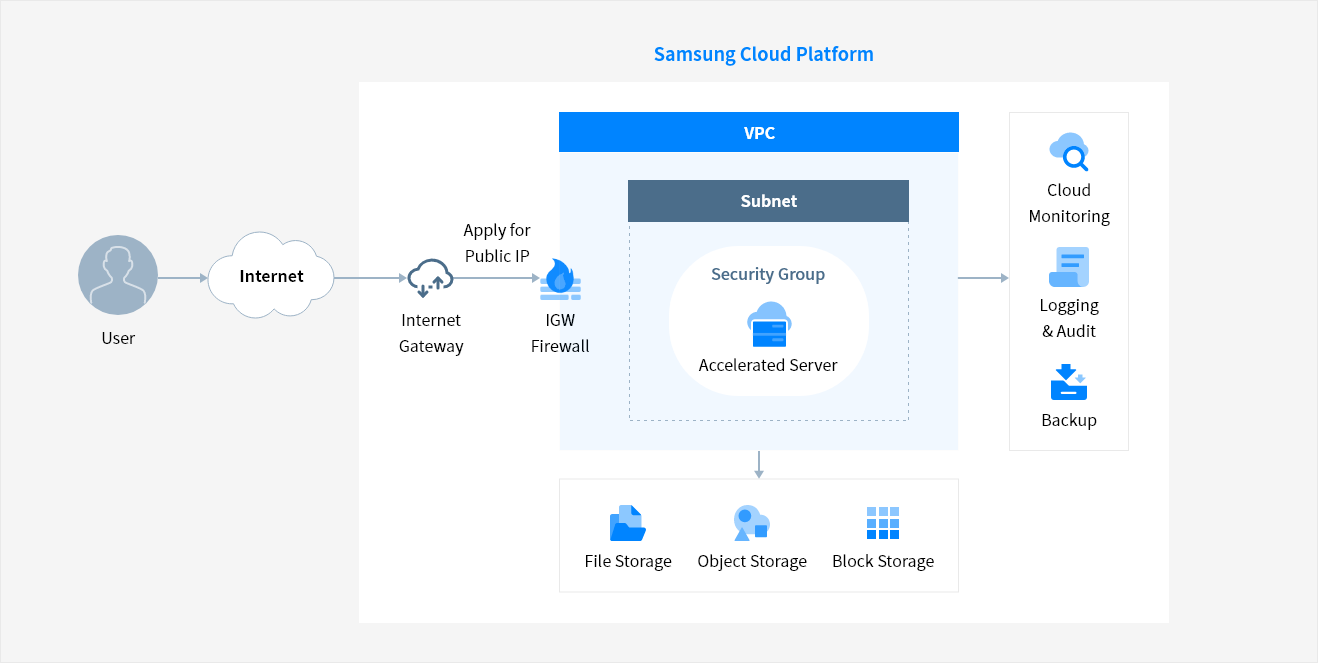
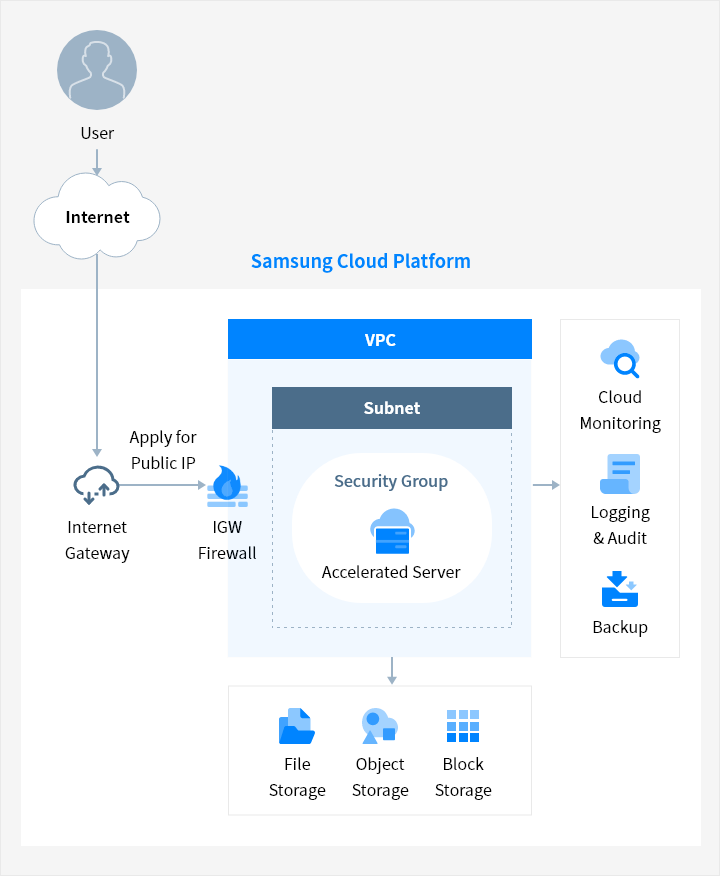
Samsung Cloud Platform Internet Gateway → (Apply for Public IP) → IGW Firewall → VPC → [Cloud Monitoring, Logging and audit, Backup]
VPC → [File Storage, Object Storage, Block Storage]
VPC : Subnet [Security Group - Accelerated Server]
Key Features
-
Server creation/management
- Select GPU or NPU card based on task type and required specifications(B300, H100, A100 and RNGD)
- Offer various OS standard images for creating resources conveniently(RHEL and Ubuntu)
- Securely connect to the OS using key pairs
- Manage tag creation/revision
-
Storage and network connection
- Provide additional storage besides OS disk
- Set up subnet/IP and enable the use/turn off NAT IP setting
- Provide Security Group integration setting
※ Custom images do not support backup services
-
Convenient service management
- Manage creation or deletion of custom images
- Manage custom image copies between accounts


Whether you’re looking for a specific business solution or just need some questions answered, we’re here to help