Connecting Global Talent as One
Yanolja builds a data-driven HR operating model with One HR platfrom
Yanolja One HR Transformation at a Glance
- Building a Global Post-M&A HR Integration Framework: By standardizing HR master data—including organizational structures, job classifications, and employment types—Yanolja established a unified foundation for rapidly applying consistent HR standards across its global member companies in more than 30 countries, enabling them to operate as one integrated organization.
- Achieving End-to-End Visibility into Global Workforce Data: More than 70,000 HR data records previously dispersed across global member companies were consolidated into a single platform, enabling real-time visibility and standardized analysis of global workforce information and labor costs.
- Connecting the Entire HR Journey, from Recruitment to Payroll: Recruitment, onboarding, performance management, and payroll were integrated into one seamless HR process, reducing new hire onboarding administration time by approximately 40% and payroll processing time by approximately 50%, while delivering a frictionless employee experience.
- Transforming HR into a Data-Driven Strategic Function: By eliminating repetitive manual data consolidation, Yanolja established a data-driven HR operating model that empowers HR teams to proactively recommend workforce and organizational strategies based on real-time people data
Many organizations talk about becoming data-driven. Yet few can answer a fundamental question with confidence: "Where are our people with the right skills, and how are they deployed across the organization?"
For companies that have expanded rapidly through global growth and M&A, the challenge becomes even greater. Different countries operate on different HR systems, and each organization classifies and manages talent according to its own standards.
Global travel technology company Yanolja faced the same challenge. As the company rapidly expanded its business across more than 30 countries and over 60 offices, it became clear that its HR operating model needed to evolve to support the next stage of global growth.
M&A Was Complete, But the Organization Wasn't
As Yanolja expanded its global B2B business, the company strengthened its capabilities through a combination of strategic acquisitions and partnerships. While an acquisition is completed when the contract is signed, integrating organizations truly begins afterward.
With each newly acquired member company came another HR system. In Korea, HR operations were centered on SAP SuccessFactors, while overseas member companies relied on a variety of local solutions, including Keka, HiBob, and DreamTeam.
Recruitment, performance management, and payroll were all managed in separate systems, resulting in fragmented data and making it difficult to establish a single, consistent view of the global workforce. The existing HR environment had been designed primarily for domestic operations, making it challenging to scale rapidly across global member companies or adapt to organizational changes. As a result, the employee experience was equally fragmented across disconnected systems.
To understand the workforce of more than 4,000 employees worldwide, HR teams had to extract data from multiple systems every month and manually consolidate it in spreadsheets. This labor-intensive process reduced data reliability and slowed decision-making. What Yanolja needed was a Single Source of Truth—a unified HR language that would enable every member company to view talent through the same standards and make decisions based on the same trusted data.
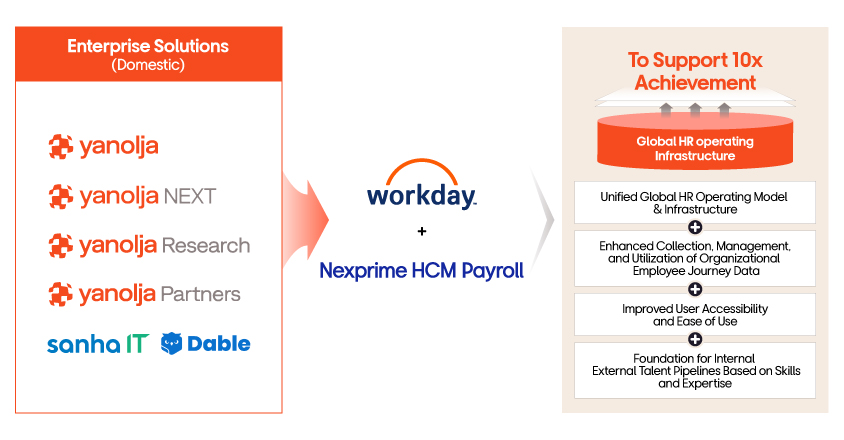 Building a Global HR Operating Model Source: Samsung SDS
- yanolja
- yanolja NEXT
- yanolja Research
- yanolja Partners
- sanha IT Dable
- Integration of global-standard HR operating systems and infrastructure +
- Enhanced accumulation, management, and utilization of organizational and employee journey data +
- Improved user accessibility and ease of use +
- Foundation for building internal and external talent pipelines based on roles and expertise
Q. What was the biggest challenge before implementing Workday?
"The biggest challenge was that our headquarters and global member companies often interpreted the same HR metrics differently. Within Korea, close communication helped bridge those gaps. But across our global organizations, differences in language and culture made that much more difficult. Even when everyone spoke English, the same terms often carried different business meanings and implications. Establishing a common understanding across the organization became one of the biggest barriers to building a unified global HR governance model."
Building a Common Standard Before Implementing a System
Yanolja viewed this initiative as far more than a system implementation or a technology upgrade. It was a global organizational integration project and a fundamental transformation of its HR operating model. The company recognized that simply "lifting and shifting" outdated, fragmented processes onto an expensive cloud platform would not deliver meaningful change.
Instead, the first priority was to establish a solid data foundation. Yanolja conducted a comprehensive review of 154 HR data domains comprising 2,944 data elements that defined its HR operations—including organizational structures, job architecture, worker types, and employment types. Duplicate, obsolete, and non-standard data were cleansed, and a standardized global data model was established to support future expansion.
The company also redesigned its organizational structure and job architecture to create a globally consistent framework. Supporting HR codes—including worker types and employment types—were redefined using a global standard code set, enabling employees and workforce data to be managed and understood consistently regardless of location.
However, standardization did not mean standardization at the expense of flexibility.
Business environments, organizational structures, and workforce requirements varied significantly from country to country. Overly rigid or highly granular standards could limit organizational agility, restrict employees from exploring new career opportunities, and create barriers to cross-border talent mobility.
For this reason, Yanolja invested significant time in designing a flexible global HR governance model—one that enables every member company to operate on a common data standard while respecting local business characteristics and supporting employees' long-term career growth.
Q. What was the most memorable moment during the implementation?

"One HR leader from one of our global member companies once said, 'I'd rather have a bigger hat.' What they meant was that if job structures become too narrowly defined, people tend to confine themselves to those roles. By creating broader and more flexible role definitions, employees are encouraged to take on new responsibilities, gain diverse experiences, and grow their careers. That insight prompted us to revisit our initial design and ultimately helped us build a flexible governance model that both our headquarters and global member companies could embrace."
A Unified View of Talent Across the Globe
For Yanolja, this project was about far more than consolidating systems—it was about managing its global workforce through a single, consistent standard.
The company integrated its most critical HR data into a single platform, including 7,850 organizational history records, 3,349 employee master records, 70,767 workforce movement records, and 10,604 compensation records. Together, these datasets established a trusted foundation for global HR operations.
As a result, Yanolja moved beyond simply tracking headcount. The company can now identify where critical talent gaps exist, which skills are concentrated in specific countries or organizations, and how its global workforce is evolving—all based on a common data standard.
The transformation also fundamentally changed the role of HR.
Previously, HR teams could only respond after receiving requests for hiring or organizational changes from global member companies. Gathering data from local HR teams, consolidating spreadsheets, and comparing information across countries required significant time and effort.
Today, HR leaders have real-time visibility into workforce distribution, headcount by entity, job function and job level, as well as workforce movement trends—all from a single dashboard. This enables the organization to identify regional talent shortages and workforce imbalances before they become business issues, allowing HR to proactively plan recruitment strategies and workforce budgets.
As a result, HR has evolved from a reactive administrative function into a strategic business partner—leveraging real-time workforce data to anticipate organizational change, forecast talent demand, and support executive decision-making.
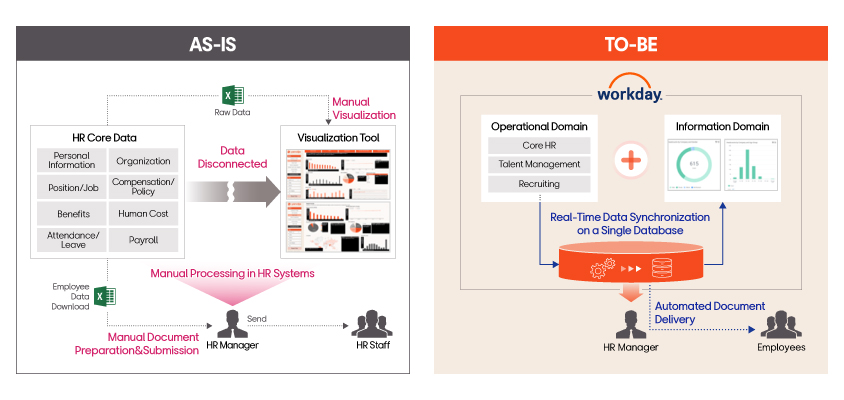 Integrating Fragmented HR Operations Source: Samsung SDS
Q. What do you consider the greatest achievement of this project?
"The biggest achievement wasn't standardizing our systems—it was unifying our data. Today, we can analyze our organization through a common set of standards and a shared perspective. More importantly, we've established a solid foundation for data-driven decision-making across the business."
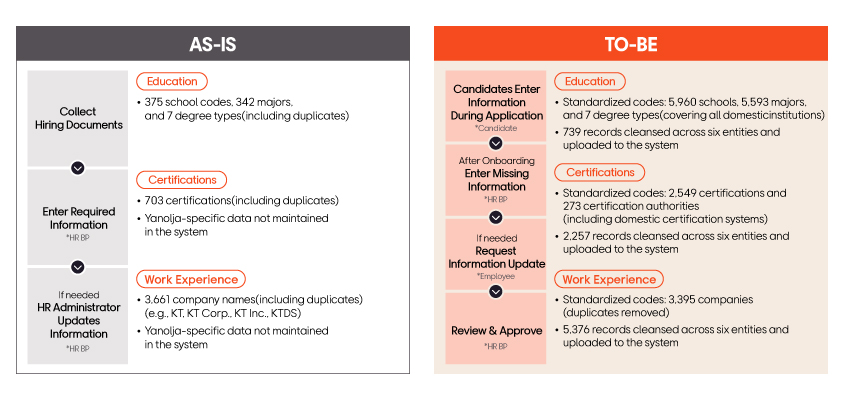 Standardizing Global HR Data Source: Samsung SDS
-
Collect Hiring Documents
-
AS-IS
Education
- . 375 school codes, 342 majors. and 7 degree types(including duplicates)
-
Enter Required Information *HR B
Certifications
- . 703 certifications(including duplicates)
- . Yanolja-specific data not maintained in the system
-
If needed HR Administrator Updates Information*HR BP
Work Experience
- . 3.661 company names(including duplicates) (e.g .. KT, KT Corp., KT Inc., KTDS)
- . Yanolja-specific data not maintained in the system
- Candidates Enter Information During Application *Candidate
- After Onboarding Enter Missing Information *HR BP
- If needed Request Information Update *Employee
- Review & Approve *HR RP
- · Standardized codes: 5.960 schools. 5.593 majors. and 7 degree types(covering all domesticinstitutions)
- · 739 records cleansed across six entities and uploaded to the system
- . Standardized codes: 2.549 certifications and 273 certification authorities (including domestic certification systems)
- . 2.257 records cleansed across six entities and uploaded to the system
- . Standardized codes: 3.395 companies (duplicates removed)
- . 5,376 records cleansed across six entities and uploaded to the system
A Seamless Employee Experience, from Recruitment to Performance
One of the most significant outcomes of this transformation was the creation of a seamless employee experience across the entire HR lifecycle.
Previously, key HR processes—including recruitment, employment contract signing, employee onboarding, performance management, and payroll—were handled in separate systems with little integration. HR teams had to navigate multiple applications, manually copy and paste data, and manage repetitive administrative tasks, increasing the risk of data inconsistencies and human error.
Today, once a candidate is hired, their information is automatically converted into an employee profile. From compensation setup and electronic contract signing to onboarding, every step is connected through a single, end-to-end workflow. As a result, the administrative effort required for new hire onboarding has been reduced by more than 40%, while delivering a faster and more consistent onboarding experience.
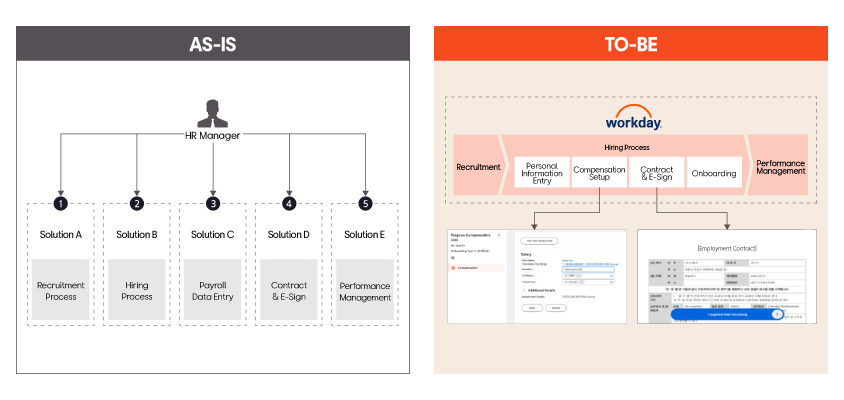 Integrating Fragmented HR Solutions Source: Samsung SDS
The transformation extended well beyond operational efficiency.
Instead of spending nearly 70% of their time collecting and preparing raw data for reports, HR teams now leverage real-time workforce dashboards to deliver predictive workforce insights and proactively support executive decision-making.
At the same time, employees benefit from a seamless, end-to-end HR experience, enjoying consistent and connected services throughout every stage of their journey—from hiring and onboarding to growth and career development.
A Partnership That Simplified Complexity
One of the greatest challenges of the project was maintaining a global standard HR platform while accommodating Korea's complex payroll requirements and integrating numerous enterprise systems. Drawing on its extensive global project experience and deep expertise in HR transformation, Samsung SDS addressed these challenges through a unified architecture.
The solution integrated the full HR lifecycle—from Recruiting, Core HCM, Talent Optimization, and Compensation—while seamlessly connecting more than 50 interfaces. These included OKTA for enterprise identity and access management, Nexprime HCM for payroll, Shiftee for workforce scheduling, Slack for collaboration, and the company's Executive Information System (EIS), enabling seamless integration across nine internal and external enterprise systems. Standardized approval workflows were implemented across the group, while dedicated processes were designed for Korean member companies to comply with local labor regulations and tax requirements.
One of the defining moments of the project came during the End-to-End (E2E) testing phase, which reinforced Yanolja's confidence in Samsung SDS as a trusted implementation partner. Hundreds of persona-based scenarios were validated across the entire employee lifecycle—from recruitment and hiring to employee data management, compensation setup, and payroll generation.
Samsung SDS also successfully mapped Korea's complex payroll structures—including both annual salary and hourly wage models—from Workday to Nexprime HCM, while carefully resolving complex exception scenarios such as organizational visibility for employees with multiple assignments. Through meticulous testing, rapid issue resolution, and close collaboration, Samsung SDS ensured payroll data integrity, reduced payroll processing time by 50%, and enabled a stable, successful system go-live.
Q. What impressed you most about working with Samsung SDS?

"In a global implementation project, unexpected challenges are inevitable. There were many situations where we had to reflect real operational requirements, and standard processes alone were not enough to address differences in local regulations and ways of working across countries. What impressed us most was that Samsung SDS never simply said, 'That's beyond the standard functionality.' Instead, they worked closely with us to find practical solutions that fit Yanolja's business and operating environment.
Throughout repeated Unit Tests, End-to-End (E2E) Tests, and Payroll Parallel Tests, the team thoroughly validated both data and business processes. They compared payroll calculation results between the legacy and new systems multiple times to ensure the highest level of data accuracy. In addition, their structured support—from administrator training and change management guidance to detailed operational manuals—enabled us to stabilize the new system quickly and achieve a smooth transition after go-live."
Throughout the project, Samsung SDS acted as more than a technology implementation partner. Rather than applying standard functionality as-is, the team worked closely with Yanolja to design practical solutions that balanced global best practices with the company's unique business requirements. Beyond system implementation, Samsung SDS also supported change management and operational stabilization, helping ensure that Yanolja's global HR transformation translated into measurable business outcomes.
"One HR platform is our shared playing field"
Following the successful completion of the project, Yanolja views this transformation as the first major milestone in building its global One HR platform. The global standard code sets and common HR processes established through this initiative provide a scalable foundation that can be reused as new member companies join the group, enabling people and data to be managed under a single, consistent standard regardless of future expansion.
But this transformation is about far more than deploying the same HR system across global member companies. It is about creating a truly unified global organization—One Team—where people can collaborate beyond geographical boundaries. Regardless of which country or member company they belong to, employees can access the same global organizational structure through a single platform, collaborate more effectively, and, in the future, explore internal career opportunities and cross-border mobility with greater transparency across the global organization.
Q. If you could describe the One HR platform in one word, what would it be?

"I'd describe it as a playing field. In the past, each organization was playing on its own field, with different rules and standards. Through this project, we've created one shared playing field where everyone at Yanolja—regardless of location or organization—can work together under the same rules and with the same understanding."
Q. What advice would you give to companies embarking on a global HR transformation?

"My advice is simple: Don't just lift and shift. Moving outdated, fragmented processes onto an expensive cloud platform won't deliver real transformation. There are many great solutions available, but just because one works well for another company doesn't mean it's the right fit for yours. Before selecting a solution, define your own standards—ones that reflect your organization's unique characteristics and the realities of your business. That should always come first."
This project marks not the end, but the beginning of Yanolja's HR transformation journey.
By establishing a unified foundation for managing people and data, Yanolja is now well positioned to expand its AI-powered HR capabilities. Building on this foundation, the company plans to continuously advance its data-driven HR strategy through initiatives such as skills gap analysis, personalized career path recommendations, and cross-border talent mobility.
In the past, each organization operated on its own playing field with different rules and standards. Today, everyone at Yanolja shares one common playing field, built on the same standards and a common understanding.
Global HR transformation is not simply about replacing systems—it is about creating a shared playing field where the entire organization can grow and succeed together. Leveraging its expertise in both global best practices and local business requirements, Samsung SDS will continue to help organizations connect people and data through a single, trusted standard, enabling them to adapt with confidence in an ever-changing business environment.