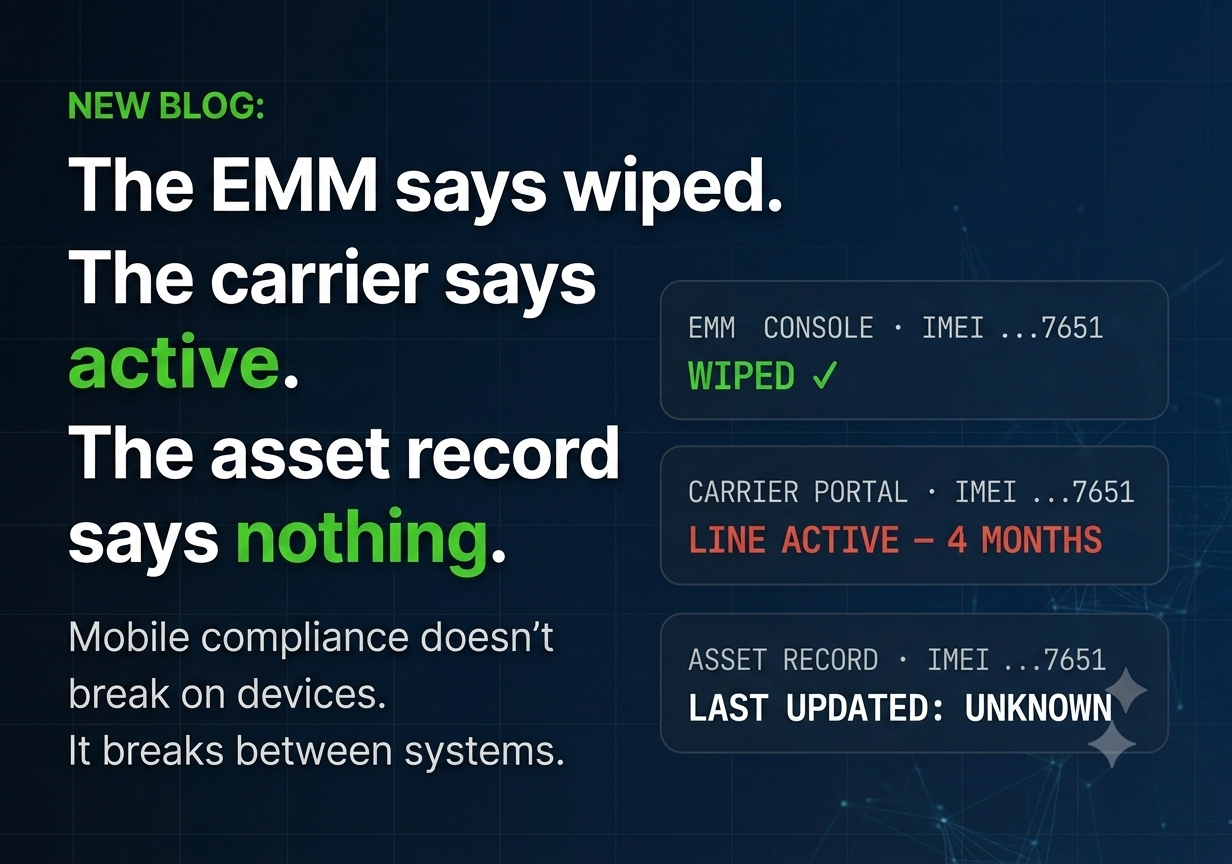
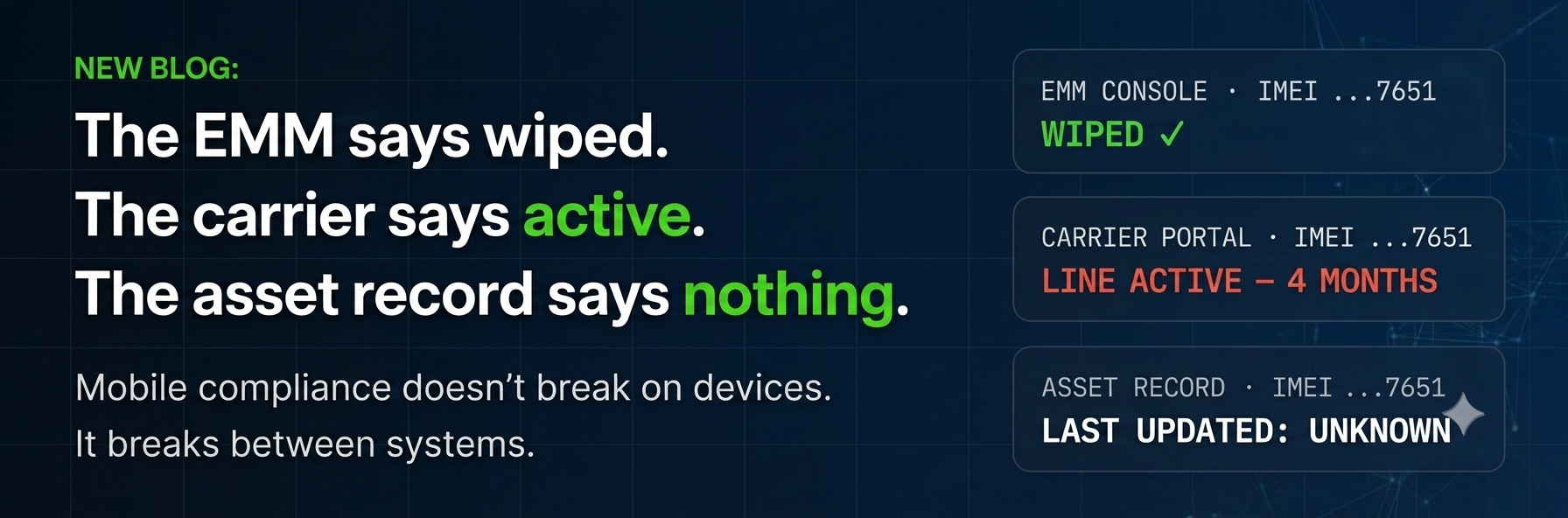
If you're responsible for enterprise mobility and security, your EMM is probably doing its job, devices encrypted, policies enforced, enrollment locked down. But mobile device compliance doesn't usually fail at the device. It fails in the spaces between systems: the wiped phone whose carrier line stayed active for four months, the departed employee whose device never made it back, the auditor who asked for one device's complete history and received three records that didn't agree. No amount of device policy closes those gaps. Here's how leading organizations close them.
See how Zero Touch Mobility helps close the compliance gaps your EMM can't address.
What your EMM already secures
Let's be precise about what's working, because the gaps only make sense against that backdrop.
Device-level security is the most mature part of enterprise mobility. If your fleet is enrolled in Intune, Jamf, Workspace ONE, Knox Manage or a comparable platform, the device itself is well defended: encryption enforced, passcode policy applied, app catalogs controlled, remote lock and wipe available on demand. Enterprise mobile device security, at the level of the individual handset, is a solved problem, and your EMM deserves the credit.
So why do mobile audits still hurt? Because an auditor isn't evaluating your device policy. They're evaluating whether your security-critical processes complete, and whether you can prove they did. Those are two things no EMM was designed to guarantee on its own.
The three blind spots device policy can't close
1. Security events that complete halfway
A lost or stolen device triggers actions in at least three separate systems: the EMM must lock or wipe it, the carrier must suspend the line, and the asset record must reflect what happened. The EMM step almost always happens. It's one click in a console someone is already looking at. The rest depends on a person remembering to log into a different portal, on a different timeline, while handling thirty other things.
The result is security events that are technically "handled" but factually incomplete. The device is wiped; the line quietly bills for months. One enterprise found that a single improperly handled SIM suspension cost roughly $10,000 on one line, an error category that only exists because the carrier step lives outside the workflow that triggered it.
"A security action that completes in one system and fails in another isn't a partial success. To an auditor, it's a finding."
2. Offboarding without proof
An employee leaves. HR closes the ticket, IT unenrolls the device in the EMM, and on paper the offboarding is done. But look at what typically has no confirmation:
| × |
Physical return. Was the device actually shipped back, or is it in a drawer, holding corporate data the wipe never reached because it was powered off? |
| × |
Line termination. Was the carrier contract closed, or is it one of the 5–15% of enterprise lines still billing against devices nobody uses? |
| × |
Record closure. Does the asset record show a completed end-of-life, wiped, returned, deregistered, or does it just stop being updated? |
Compliance requires proof of completion, not evidence of intention. A policy that says devices must be returned and wiped is not the same as a record showing this device was returned and wiped, on this date, with this outcome.
3. An audit trail split across five systems
Now the auditor asks the question every mobility team dreads: "Show me the complete history of this device, who was assigned to it, what happened when it was reported lost, when it was wiped, when the line was closed."
Today the honest answer is assembled from EMM logs, carrier invoices, help desk tickets, and an asset spreadsheet, four sources that use different identifiers, disagree on dates, and were never designed to tell one story. Reconstructing a single device's timeline takes an afternoon. An audit samples fifty devices. That's the math behind why mobile device compliance reviews consume weeks of preparation in organizations whose devices are, individually, perfectly secure.
📋 Where would your mobile compliance break first?
Every organization has different compliance challenges. Talk with our team about your mobile environment, and we'll show you how Zero Touch Mobility can help close compliance gaps and simplify device lifecycle management.
Closing the gaps: completion and proof
The fix isn't a better EMM. Yours is already doing its part. What's missing sits above the EMM, the carrier, and the asset system: a layer that guarantees two things device policy never can.
| ✓ |
Workflows that run to completion across every system. A lost-device event that locks the device, suspends the carrier line, orders the replacement, and updates the record as one connected sequence, where no step can be silently skipped, because no step depends on someone remembering a second portal. |
| ✓ |
One auditable record per device. Every action, assignment, lock, wipe, line change, return, retirement, written to a single timeline, keyed on the device's IMEI, so the auditor's question is answered in one lookup instead of one afternoon. |
| ✓ |
Continuous policy monitoring, not annual discovery. Fleet rules like approved OS versions and required enrollment checked continuously against what your EMM actually reports, with violations surfaced as trackable tasks the day they appear, not findings twelve months later. |
How Zero Touch Mobility closes mobile compliance gaps
Zero Touch Mobility (ZTM) from Samsung SDS is built as exactly this layer. It connects to your existing EMM, Intune, Jamf, Workspace ONE, Knox Manage and others, plus your carriers and logistics providers, and runs security-critical events as single end-to-end workflows. Your EMM keeps enforcing device policy. ZTM makes sure everything around that enforcement actually finishes, and that the proof exists.
Lost and stolen, as one workflow. The employee reports the device themselves. ZTM guides them through locate-and-ring first. Most "lost" devices are recovered this way, avoiding a disruptive wipe. If recovery fails, one workflow locks or wipes via the EMM, suspends the carrier line, orders the replacement, and updates the record. Every step logged, nothing dependent on a second portal.
Offboarding that closes the loop. A departure triggers the return label, the wipe and unenrollment, the line termination, and the record closure as one sequence, with confirmation at each step. For BYOD devices, ZTM performs a work-profile-only wipe that removes corporate data while preserving the employee's personal content, because compliance includes respecting the data that isn't yours.
One audit trail for every device. Every change on every device, assignment, security command, carrier action, lifecycle event, is captured in a single native audit trail. When the auditor asks for a device's history, it's one record, one timeline, one answer.
Policy monitoring across the fleet. Define your mobility rules, mandatory enrollment, role-based device eligibility, and ZTM continuously checks the fleet against them through your connected EMM, flagging exceptions as tasks the moment they drift.
This combination, rigorous asset tracking, enforced completion of security workflows, and continuous compliance monitoring, is why ZTM has seen particularly strong adoption in financial services and other regulated industries, where organizations must demonstrate that devices are properly enrolled, managed, and compliant throughout their lifecycle, not just assume they are. ZTM is featured in the 2025 Gartner Market Guide for Managed Mobility Services and operates in production across more than 90 countries.
Walk through your mobile compliance posture with a specialist
Bring your current lost-device process, your offboarding checklist, and your last audit's pain points. We'll map where the gaps typically sit against how your fleet operates, and give you an honest view of which ones are worth closing now.
No commitment required. If an audit is already on your calendar, mention it. We'll prioritize the evidence-trail conversation.

